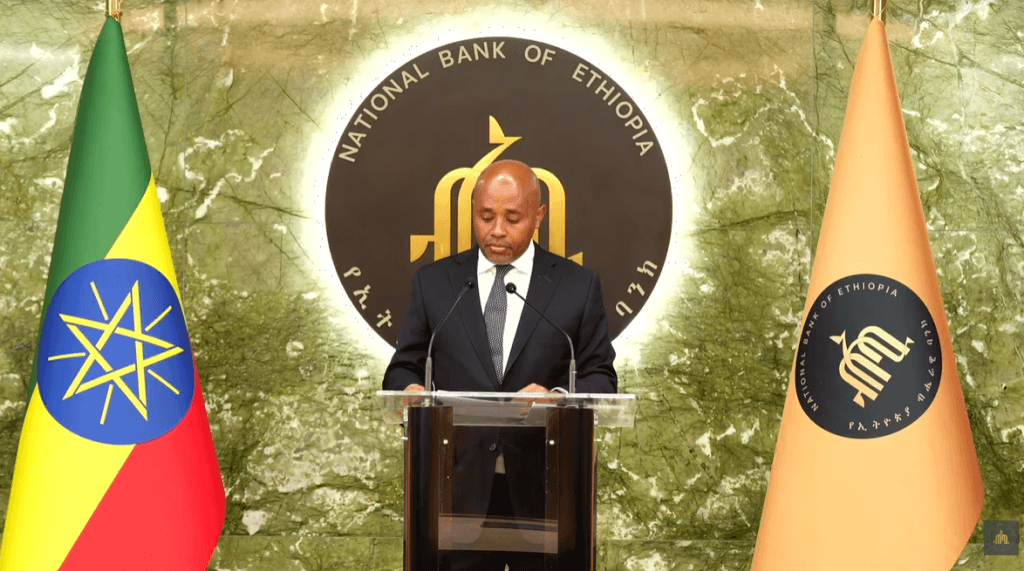


The International Monetary Fund (IMF) has urged the National Bank of Ethiopia (NBE) to prepare a long-term exit from its role as the country’s sole buyer of artisanal gold, warning that the arrangement is injecting substantial liquidity into the economy and complicating efforts to contain inflation.
The recommendation is contained in the IMF’s Fifth Review of Ethiopia’s US$3.4 billion Extended Credit Facility (ECF) program, published in July 2026. The Fund called on the NBE to develop a comprehensive strategy to exit the gold market by December 2026, while also preparing a plan by September 2026 to gradually phase out the premium it pays artisanal miners, currently set at 5–15 percent above international gold prices.
According to the IMF, the central bank’s gold purchases have become a significant source of reserve money creation. Reserve money growth accelerated to 67 percent year-on-year in March 2026, up from 43 percent in February, largely reflecting increased gold purchases. Since the NBE pays miners in birr, the transactions inject liquidity into the banking system, with much of the cash flowing through the Commercial Bank of Ethiopia, which has a dominant presence in gold-producing regions.
The Fund warned that the resulting liquidity has forced the NBE to conduct increasingly costly open market operations to absorb excess money from the financial system. It also noted that the gold premium may be contributing to pressures in the parallel foreign exchange market, as gold exports have become an increasingly important source of foreign currency.
“Improvements in NBE’s gold market operations and eventual exit from the gold market will channel more foreign exchange resources through the private sector,” the IMF said, adding that any exit strategy should remain consistent with Ethiopia’s foreign reserve accumulation objectives.
The recommendation comes as Ethiopia has significantly expanded the use of foreign exchange auctions. During the first eleven months of the fiscal year, the NBE conducted 14 foreign exchange auctions totaling US$2.5 billion, recycling foreign currency earned from strong gold exports back into the private sector.
The IMF also highlighted broader monetary developments. Private sector credit expanded by around 50 percent year-on-year, while credit to state-owned enterprises declined by 10 percent and lending to the government remained broadly unchanged. Although inflation had fallen to single digits earlier in the year, it increased from 9.4 percent in March to 13.4 percent in May, driven largely by higher fuel prices.
Despite the recent increase in inflation, the Fund said the NBE’s current monetary policy stance remains appropriate but emphasized that the central bank should be prepared to tighten policy further if inflationary pressures become more persistent.
Beyond monetary policy, the review outlines several reforms aimed at strengthening Ethiopia’s domestic debt market. The government committed to updating and publishing a revised Treasury bill and government bond issuance directive by October 2026, adopting a master repurchase (repo) agreement by December 2026, and launching a secured repo market to improve liquidity and deepen the local currency bond market.
The IMF noted that investor demand for government securities, including longer-term maturities, has strengthened following the establishment of the central securities depository and the removal of mandatory bond purchase requirements for banks.
The report also pointed to political continuity following the June 1, 2026 general elections, in which the ruling Prosperity Party retained a decisive parliamentary majority. According to the Fund, the election outcome is expected to support continued implementation of Ethiopia’s Homegrown Economic Reform Agenda, including planned reforms to the gold market.
Source: IMF Country Report No. 26/174, Fifth Review Under the Extended Credit Facility Arrangement, July 2026.