

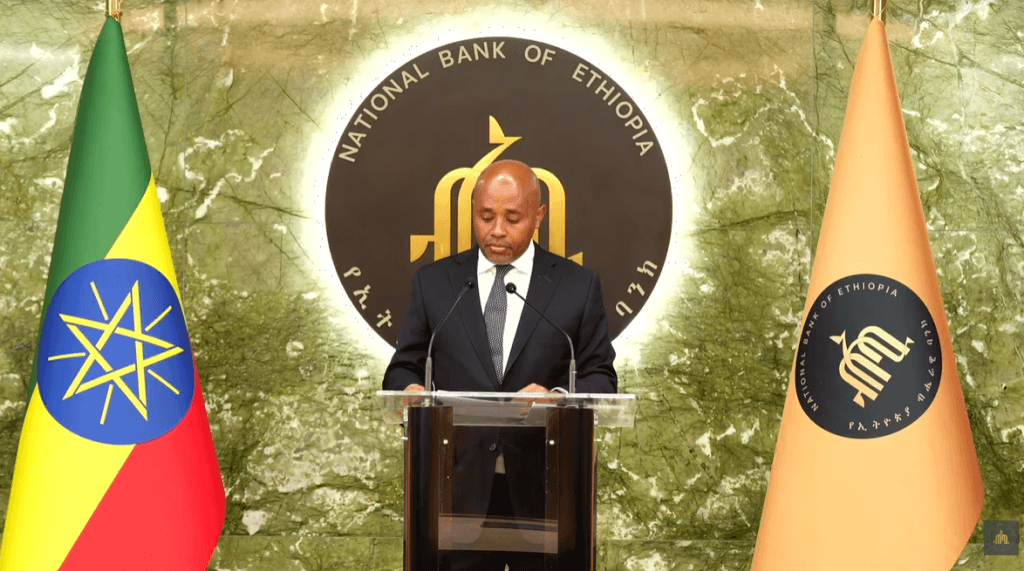
Ethiopia has taken its biggest step yet toward a modern interest-rate-driven monetary policy framework, with the National Bank of Ethiopia (NBE) removing the credit growth ceiling that restricted bank lending for nearly three years while raising its benchmark policy rate for the first time.
Following the seventh meeting of the Monetary Policy Committee (MPC), the central bank lifted the credit growth cap entirely and increased the National Bank Rate from 15 percent to 16 percent, a move designed to ensure that interest rates, rather than administrative controls, become the main tool for managing liquidity and inflation.
The policy shift comes at a critical moment for the economy. Inflation, which fell into single digits in December 2025 for the first time in almost a decade, has accelerated again, reaching 13.4 percent in May 2026 as global oil disruptions linked to the US–Iran conflict pushed up fuel, transport, and production costs.
The NBE’s latest decisions represent a delicate balancing act: allowing banks greater freedom to lend while maintaining a restrictive monetary stance to prevent renewed inflationary pressures.
The End of the Credit Cap Era
The credit ceiling was introduced in August 2023 when Ethiopia was battling inflation rates close to 30 percent and rapid expansion in bank lending was adding pressure to prices.
Initially, banks were restricted to annual credit growth of 14 percent. The limit was later eased to 18 percent in December 2024 and 24 percent in September 2025 as inflation pressures moderated and the economy stabilized. However, the full removal of the cap was repeatedly delayed as the NBE sought to strengthen its alternative policy tools.
The central bank now says the measure has served its purpose.
According to the MPC, the credit cap was introduced as a temporary instrument during a period of high inflation and was always intended to be replaced by a market-based monetary framework. Its removal, the Committee emphasized, does not represent a shift toward easier monetary policy.
Instead, the NBE said it will continue using indirect monetary tools to maintain tight financial conditions and manage inflation risks.
The transition marks a major change in how Ethiopia manages credit growth. Rather than limiting banks directly, the central bank will increasingly rely on policy rates, reserve requirements, and liquidity management tools to influence lending behavior.
A Rate Hike to Replace Administrative Controls
To support the transition, the NBE raised its policy rate by one percentage point to 16 percent.
The increase is the first adjustment since the central bank introduced the interest-rate-based framework in July 2024, when the National Bank Rate was initially set at 15 percent.
The move sends a clear signal that the NBE intends monetary policy rates to become the primary mechanism for controlling inflation and credit conditions.
The central bank also introduced a targeted safeguard against excessive lending. If credit expansion after the removal of the cap threatens inflation stability, the NBE can impose additional reserve requirements on individual banks based on their loan-to-deposit ratios.
Unlike a broad restriction affecting the entire banking sector, the measure would allow the regulator to target institutions that expand lending too aggressively.
Supporting Exporters Through FX Reforms
Alongside monetary policy changes, the NBE announced further adjustments aimed at strengthening Ethiopia’s foreign exchange market.
The foreign exchange transaction commission charged by banks was reduced from 2.5 percent to 1.5 percent, lowering the cost of FX transactions and helping reduce pressure on import prices.
More significantly, the foreign exchange surrender requirement for exporters was reduced from 50 percent to 30 percent.
Under the previous arrangement, exporters were required to sell half of their foreign currency earnings to banks. The reduction allows exporters to retain a larger share of their foreign currency proceeds, which the NBE said would improve competitiveness and encourage export growth.
The move builds on the broader foreign exchange reforms introduced earlier this year, including exemptions from surrender requirements for service exporters and operators in Special Economic Zones.
Inflation Returns as External Shocks Hit
The policy changes come against a mixed economic backdrop: strong growth alongside renewed inflation pressures.
Ethiopia’s economy expanded by 9.2 percent in FY2024/25, exceeding the average growth rate of the previous eight years. Industry was the largest contributor, adding 3.7 percentage points to growth, supported mainly by gold production. Services contributed 3.1 percentage points, while agriculture added 2.3 percentage points.
However, inflation has reversed some of its recent progress.
After reaching 9.7 percent in December 2025, headline inflation increased to 11.7 percent in April and 13.4 percent in May. Food inflation climbed to 15 percent, while non-food inflation reached 11.1 percent year-on-year.
The NBE attributed much of the recent increase to external factors, particularly higher oil prices and transport costs, rather than excessive domestic demand.
The central bank expects inflation to decline by the end of 2026 but acknowledged that prices are likely to remain elevated in the near term.
Money Supply Growth Slows, Liquidity Remains High
Recent monetary data shows that growth in money supply has started to moderate.
Base money growth slowed to 43 percent, compared with 66.4 percent during the same period a year earlier, while broad money growth eased to 32.7 percent from 35.2 percent.
The NBE noted that recent monetary expansion has been driven more by foreign exchange accumulation linked to gold purchases rather than domestic credit expansion.
At the same time, Ethiopia’s financial system remains highly liquid.
The average yield on 91-day Treasury bills declined to 11 percent in May, from 16.1 percent a year earlier, as auctions attracted excess demand of about Birr 667.8 billion.
The interbank lending rate also declined from 18 percent in March to 14.6 percent in May, while cumulative interbank market transactions reached Birr 3 trillion since the market began operations in October 2024.
This liquidity environment provided room for the NBE to raise rates while removing the credit ceiling.
Stronger External Position Supports Policy Shift
Ethiopia’s external position has also improved significantly.
The current account deficit narrowed from $6.2 billion in FY2023/24 to $1.8 billion in FY2025/26, supported by stronger exports, increased remittance inflows, and improved capital inflows.
Foreign exchange reserves have also increased significantly compared with pre-reform levels following the implementation of market-based FX reforms.
Fiscal discipline has further supported monetary stability. The government has avoided direct borrowing from the central bank since the reforms began and has increasingly financed deficits through the Treasury bill market.
Treasury bill financing contributed Birr 206.5 billion in FY2025/26, while the fiscal deficit stood at 0.9 percent of GDP during the first ten months of the fiscal year, down from 1.6 percent a year earlier.
The Next Test for Ethiopia’s Monetary Framework
The removal of the credit cap represents the completion of one phase of Ethiopia’s monetary reform agenda, but it also begins a more challenging test.
The key question now is whether the new interest-rate framework can effectively manage credit expansion without the direct controls that previously restricted bank lending.
Markets will closely watch how quickly banks increase lending, whether the 16 percent policy rate is sufficient to contain inflation pressures, and whether the current oil shock fades as expected.
For Ethiopia’s central bank, the transition marks a move away from emergency controls toward a more conventional monetary policy system. The success of the new framework will depend on whether market-based tools can deliver the same stability once banks regain full lending flexibility.