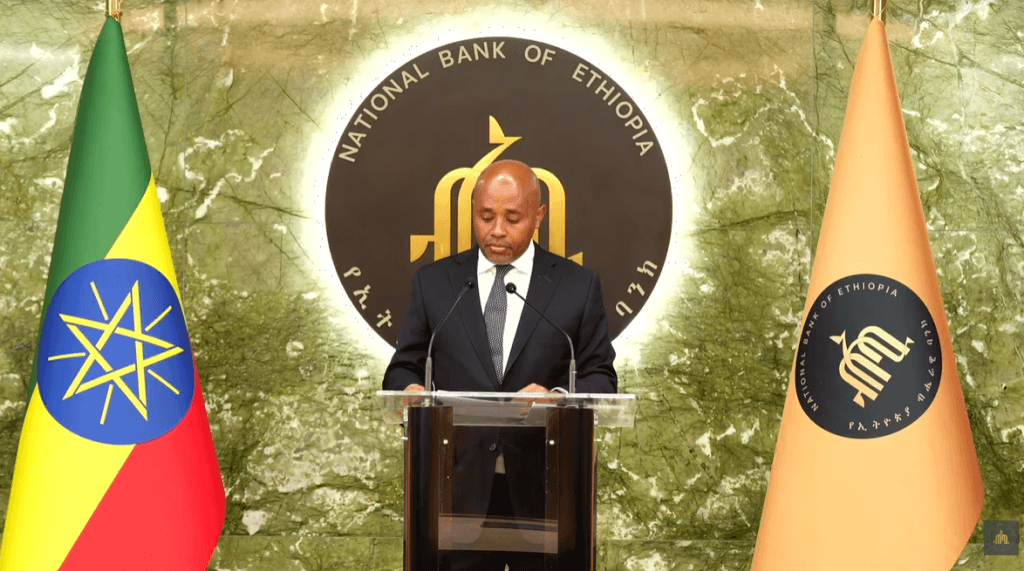


One year after launching a sweeping package of macroeconomic reforms, the National Bank of Ethiopia (NBE) says the country is on a promising path to restoring stability, boosting foreign exchange inflows, and modernizing its financial sector. The National Bank of Ethiopia marked the anniversary Tuesday by releasing a detailed review of milestones achieved so far, and what lies ahead.
The reform agenda, which officially took off on July 29, 2024, forms a core pillar of Ethiopia’s broader Homegrown Economic Reform program. Aimed at reversing macroeconomic imbalances, taming inflation, improving FX access, and attracting investment, the NBE’s policy reboot has already delivered a series of tangible outcomes. But as officials make clear, “further work lies ahead.”
“We expect 2025/26 to be the most favorable macroeconomic environment Ethiopia has seen in years,” the NBE stated, pointing to projections of declining inflation, increased FX availability, stronger exports, and balanced credit growth.
A Transformational Year in Numbers
- Inflation eased to 13.9% in June 2025, down from 20% a year earlier.
- FX inflows surged 33% year-on-year to $32 billion, driven by record exports and remittance flows.
- Interbank market activity boomed, with Birr 850 billion in lending executed electronically.
- Deposit growth hit 41%, lifting total financial sector deposits to Birr 3.5 trillion.
- Domestic credit expanded 22% to reach Birr 3.4 trillion.
- Non-performing loans (NPL) remained contained at 3.9%, well within regulatory limits.
Pillars of Reform
The central bank’s actions over the past year span three broad areas: monetary policy modernization, exchange rate liberalization, and financial sector development.
1. Monetary Policy Overhaul
NBE transitioned to a fully interest-based framework, introducing a policy rate, the National Bank Rate (NBR), for the first time in history. A newly established Monetary Policy Committee (MPC) now meets quarterly to issue forward guidance and policy updates.
Treasury bond purchase requirements for banks were repealed, and new instruments like Open Market Operations (OMO), Standing Lending/Deposit Facilities, and an Emergency Liquidity Assistance (ELA) mechanism were launched. An electronic interbank money market has begun functioning independently of central bank intervention.
Perhaps most notably, direct central bank lending to the government was fully eliminated, a move hailed by international partners as a hallmark of monetary discipline.
2. Exchange Rate and FX Reforms
The foreign exchange regime was fundamentally liberalized. The central bank now allows the market to determine the exchange rate, removing rigid surrender requirements and easing capital controls.
The FX reform has had clear results:
- Goods exports: $8.3 billion
- Service exports: $8.5 billion
- Remittances: $7.1 billion
- FDI: $3.9 billion
- FX reserves: Tripled within a year
Private sector access to hard currency has improved significantly. Average daily FX sales by banks doubled to $25 million, while monthly sales to businesses surged to $500 million from $258 million last year.
3. Financial Sector Development
The legal architecture governing the banking sector was updated with a new proclamation. Governance standards, credit assessment rules, and exposure limits have all been strengthened. Notably, the banking sector was officially opened to foreign players for the first time, paving the way for new competition and innovation.
The NBE also launched an ambitious financial inclusion and digitization push:
- Record growth in digital accounts and transactions
- Expansion of digital lending and savings services
- Enhanced credit access for SMEs
In parallel, supervision has intensified across areas like FX operations, digital payments, and consumer protection.
Capital Market & Institutional Reform
To support the growth of the Ethiopian Securities Exchange (ESX), the NBE is strengthening its Central Securities Depository (CSD) functions. A nationwide dematerialization of public and private securities is now underway, with implementation targeted for 2025–26.
The NBE also plans to finalize its institutional modernization—including a new organizational structure and the launch of a center of excellence for financial training and education.
Outlook: Optimism, but Caution
Despite significant progress, NBE Governor and senior officials caution that Ethiopia’s transformation is still in its early phases. Inflation remains above the desired single-digit threshold, and FX market depth continues to require further policy fine-tuning.
Top priorities for the year ahead include:
- Bringing inflation into the single digits
- Deepening FX markets and increasing remittance inflows
- Facilitating the entry of foreign banks
- Expanding initiatives in microfinance, insurance, and housing finance
- Strengthening financial supervision and enforcement
“Maintaining macroeconomic stability alongside growth is not just possible—it’s within reach,” the central bank asserted.
Support from International Partners
The reform program has received strong backing from the IMF, World Bank, and Ethiopia’s external creditors. The IMF recently approved a $262 million disbursement under the Extended Credit Facility, following the country’s successful completion of its first review.
National Bank of Ethiopia is signaling that the reform journey is far from over. But a year in, the numbers and policy architecture tell a compelling story. If current momentum is sustained, 2025–26 could mark a turning point for Ethiopia’s economy—where macro stability, investor confidence, and inclusive growth begin to take root more firmly than ever before says NBE in its press release.