

Good morning!
If there is one question stitching this week together, it is a simple one: who gets let in, and on what terms. The central bank drew a calendar around the dollar and slammed a door on virtual assets. Three fintechs opened a credit line to borrowers no bank would touch, a coffee platform opened the world’s doorstep to ten local roasters, and Sidama Bank stepped through the registration gate that leads to the exchange. A room full of professionals earned their entry ticket the hard way, with UK-accredited exams. And this week’s deep dive asks the uncomfortable version of the same question: why Ethiopia’s professional economy still screens its newest entrants on family income rather than ability.
A country building a modern financial system has to decide who it is building it for. This week, that decision showed up on every plate.
Now grab your buna. There’s a lot on the table.
Monetary Policy & The Central Bank
The NBE puts a calendar on the dollar: USD 500 million for the first quarter
The National Bank of Ethiopia announced it will inject USD 500 million into the foreign exchange market during the first quarter of the 2026/27 fiscal year, through four bi-weekly auctions of USD 125 million each. The schedule is now fixed: August 12, August 26, September 9, and September 23.
The headline isn’t really the number, it’s the calendar. By publishing a quarterly auction timetable, the NBE is giving commercial banks and FX market participants something they have rarely had: predictability about when and how much official hard currency will hit the market. In a system where the birr now floats and dollar access has been the single biggest constraint on importers for years, telling the market the dates in advance is itself a form of stability.
A floating currency needs a transparent tap. This is the NBE turning a discretionary intervention into a published schedule, one more piece of the market-based plumbing it committed to when the credit cap came off. Source: StockMarket.et
The NBE slams the door on virtual assets, and widens it
In the same week it was formalizing FX access, the central bank was closing off another kind entirely. The NBE reiterated that the use, purchase, sale, exchange, transfer, trading, settlement, and facilitation of transactions involving virtual assets are prohibited unless expressly authorized under the existing legal framework, and it went out of its way to say the ban is not limited to cryptocurrencies.
The clarification is the point. The prohibition now explicitly extends to any digital representation of value that can be electronically traded, transferred, exchanged, or used for payment or investment, covering exchange between virtual assets and fiat, transfers, custody, and participation in a token issuer’s offer or sale. The NBE advised the public to steer clear, citing legal, fraud, scam, cyber, operational, market-manipulation, and financial-loss risks.
As the formal system opens, digital markets that sit outside it get walled off harder. The regulator’s message is consistent: participation is welcome, but only through the front door it controls.
Inflation climbs again, to 13.9 percent in June
The cost of the plate keeps rising. Ethiopia’s annual inflation accelerated to 13.9 percent in June, up from 13.4 percent in May, with food prices continuing to do most of the pushing.
This is the third consecutive print moving in the wrong direction after inflation touched single digits (9.7 percent) back in December, and it lands right on top of last week’s decision to hike the policy rate to 16 percent and scrap the credit cap. The NBE’s new framework is being tested in real time, and June’s number is the test getting harder.
Every reform in this newsletter, the FX calendar, the rate hike, the lending freedom, ultimately answers to this figure. A modern market means little to a household watching food prices climb. Source: StockMarket.et
A sandbox for small online payments, up to 5,000 birr
Quieter but telling: the NBE is working on a regulatory sandbox to test online payments of up to 5,000 birr, a controlled, low-value environment where new digital payment products can be trialed under supervision before full authorization.
Five thousand birr is deliberately small. It’s the ceiling below which the central bank has been building lighter-touch rules, and a sandbox at that level lets fintechs experiment with everyday, small-ticket digital payments, exactly the segment where cash still rules, without betting the whole system on an untested product.
Reform doesn’t only happen at the 200-page-IMF-review scale. Sometimes it’s a 5,000-birr test box that decides whether the next merchant in the market goes digital. Source: Birrmetrics
Capital Market
Sidama Bank steps through the registration gate
The Ethiopian Capital Market Authority approved Sidama Bank S.C.’s Registration Statement on July 20, registering 1,447,002 existing shares held by the bank’s shareholders, under Articles 4 and 29 of the Public Offer and Trading of Securities Directive No. 1030/2024. As always, ECMA was clear that this is not a public offering of new shares; it is existing paper being brought into the regulated fold.
Sidama now joins a fast-lengthening line, ZamZam, Gadaa, Global Insurance and others, of institutions moving their share registers from informal dealing into a disclosed, regulated system. Wegagen Capital Investment Bank prepared Sidama’s prospectus, and the bank holds Approval in Principle from ESX, putting it firmly on the road to a listing.
The registration counter keeps ticking, one balance sheet at a time. Every registered issuer today is a candidate ticker tomorrow, and the pipeline behind the exchange is deepening faster than the board itself. Source: StockMarket.et
Banking & Islamic Finance
Rammis Bank’s assets hit 7.16 billion birr on the strength of interest-free banking
Rammis Bank, a fully interest-free lender, reported total assets of 7.16 billion birr, a 59 percent jump, at a forum with customers and executives this month. Deposits rose 75 percent to more than 5 billion birr, financing extended grew 54 percent to 2.2 billion birr, and the customer base reached 514,000. Digital banking users surged 174 percent to 157,000. The bank posted 894 million birr in total income, 401 million birr in gross profit, and 272 million birr in net profit, according to CEO Ali Ahmed, who credited expanded digital services and customer engagement.
Rammis says its ambition is to become the leading interest-free banking center in East Africa, and it is opening new branches in Addis Ababa to get there.
Interest-free banking was one of the clearest victims of the old credit cap, an institution that couldn’t park money in T-bills to offset restricted lending. With the cap now gone, watch this segment. Rammis’s 59 percent asset growth is a preview of what an un-capped Islamic banking sector can do.
Fintech & Digital Lending
Ethiopia’s digital finance firms finally get a trade body
After six years as an informal working group, Ethiopia’s digital financial service providers have formally launched the Ethiopian Digital Financial Service Providers Association (EDFSPA), bringing together 18 founding members, banks, payment switches including EthSwitch, aggregators, microfinance institutions, and mobile money operators. Backed by the EU and the UN Capital Development Fund, the body is now registered with the Civil Society Organisations Authority, and Yosef Kibret, CEO of Premier Switch Solutions, was elected chairman.
The scale behind it explains why it matters. Mobile money accounts in Ethiopia grew from 12.2 million in 2020 to 139.5 million in 2025, and digital transactions reached 9.7 trillion birr in 2023/24, overtaking cash. The association plans to back the National Digital Payments Strategy 2026–2030, pushing interoperability, merchant acceptance, and access for the underserved.
An industry this big was always going to need a single voice in the room when directives get written. This is the sector graduating from a chat group to a lobby, and a policy counterpart the NBE now has to negotiate with. Source: Birrmetrics
Kisse lends on trust instead of collateral
Meftihe Microfinance, MZ Tech, and Arifpay launched Kisse, which its founders call Ethiopia’s first social capital-based, agent-powered digital lending platform. The model splits three ways: Meftihe is the licensed lender, MZ Tech runs the platform and agent network, and Arifpay handles disbursement and repayment. Borrowers visit a local merchant agent, verify identity with their Fayda ID, and, once approved, receive funds digitally, no physical collateral required. Loans run up to 3 million birr, repayable within a month at a 0.09 percent daily rate, and Kisse says it has already approved more than 25,000.
The bet is on relationships. Where most emerging digital lenders now lean on algorithms and transaction-history scoring, Kisse leans on community trust and referrals, credit priced on who vouches for you.
In an economy where private credit is under 10 percent of GDP and only a sliver of adults have ever had a bank loan, the binding constraint isn’t demand, it’s a way to assess borrowers with no formal record. Kisse’s answer is to use the community as the credit bureau. Source: StockMarket.et
Optasia lines up an Ethiopia entry
The access story went international. Optasia, the JSE-listed, AI-driven lender that facilitated roughly USD 6 billion in credit across 38 developing markets in 2025, confirmed it is in the early stages of entering Ethiopia (and Egypt), CEO Salvador Anglada said. The firm uses AI and mobile data to extend micro-loans, working capital, and airtime advances to unbanked consumers and small businesses, and it runs a group-wide default rate of just 1.2 percent, well below the 10–15 percent write-offs typical of unsecured lending in the region.
Ethiopia is attractive precisely because it is underserved: private-sector credit sits below 10 percent of GDP, among the lowest on earth, the legacy of decades of state-led financing. The 2024 opening of the banking sector to foreign entrants is what makes a move like this possible.
Kisse, Optasia and Rammis are three doors into the same room: the vast Ethiopian credit market that formal banks never reached. One uses community trust, one uses AI, one uses Islamic finance. All three are chasing the same 90-million-strong underbanked majority. Source: StockMarket.et / Semafor
Business & Telecom
Ethio Telecom’s record revenue comes with a list of misses
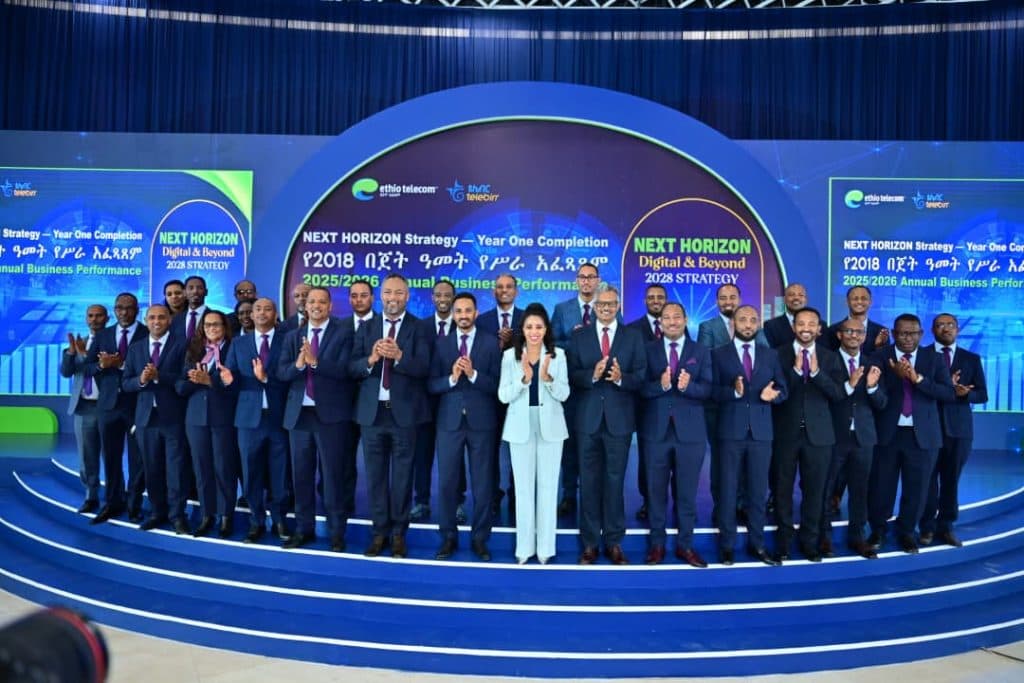
Ethiopia’s largest operator, and its newest non-bank listed company (TELE), reported ETB 215.82 billion in revenue for 2025/26, up 33.2 percent and 99.7 percent of target. But the annual report is a study in the gap between a good number and a great year. Adjusted for inflation, real growth is closer to 19–20 percent, and in dollar terms roughly 8–10 percent, figures the company itself doesn’t disclose.
Beneath the headline, several strategic targets slipped. Active mobile data users reached 51.53 million, just 91 percent of plan; device sales hit 88.8 percent; backbone fibre construction reached only 793 km against a 1,100 km target (72 percent); and telebirr customers came in at 96.9 percent. The bright spots were real, though: data and internet became the company’s single largest revenue source for the first time ever at 31.1 percent, overtaking voice at 23.5 percent, telebirr processed 2.61 billion transactions (124.6 percent of target), and the Do2Save programme drove 14.61 billion birr in cost savings, lifting the EBITDA margin to 17.9 percent.
For the market’s flagship non-bank stock, this is the first annual report investors get to price. The message is nuanced: a company growing fast in birr, more modestly in real terms, pivoting hard to data, and still leaving smartphone adoption on the table. Exactly the kind of disclosure a maturing exchange is supposed to force into the open. Source: StockMarket.et
Trade & Agriculture
Ethiopia’s coffee finally tries to sell itself roasted
EXM Global PLC, in partnership with DHL Express Ethiopia, launched the country’s first multi-brand roasted-coffee e-commerce export marketplace, putting ten local coffee brands in front of international consumers and commercial buyers directly, with DHL handling delivery to more than 220 countries. EXM manages onboarding, quality assurance, and compliance (including the EU Deforestation Regulation); DHL runs the logistics.
For a country that is Africa’s largest coffee producer but exports most of its beans green and unbranded, this is a direct attack on the oldest problem in the trade: the value, the roasting, the branding, the retail margin, has always been captured somewhere else. A digital storefront that lets an Ethiopian roaster reach a buyer in Seoul or Berlin is an attempt to keep that value at home.
Ethiopia earned a record USD 3.1 billion from coffee last fiscal year and is targeting USD 4 billion next. Platforms like this are how the country tries to grow that number by climbing the value chain, not just shipping more raw beans. Source: Birrmetrics
Fiscal
The Tax Appeal Commission worked through 17.7 billion birr in disputes
The Federal Tax Appeal Commission handled some 17.7 billion birr in disputed tax claims over the fiscal year ended June 30, clearing 9.86 billion birr of it, as the value of cases brought before it continued to rise.
The rising caseload is a quiet signal of the same tension running through Ethiopia’s reform story: a state trying to lift a tax-to-GDP ratio below 10 percent is pressing harder on collections, and businesses are pushing back through the one formal channel available. A functioning appeals commission clearing nearly 10 billion birr of contested claims is, in its own bureaucratic way, a sign of institutions maturing, the disputes are at least being adjudicated rather than settled in the dark.
As the tax base widens, so do the fights over it. Watch the gap between claims filed and claims cleared, it’s a real-time gauge of how aggressively the treasury is pushing and how hard the private sector is resisting. Source: Birrmetrics
Markets & Talent
Another cohort of certified capital-markets professionals graduates
Bruh Finance celebrated the graduation of a new cohort completing UK-accredited qualifications from the Chartered Institute for Securities & Investment (CISI): the Level 3 Certificate in Capital Markets–Securities and the International Certificate in Wealth & Investment Management.
It’s easy to skip past a graduation notice, but for a market this young it belongs in the newsletter. An exchange, a growing roster of investment banks, and a pipeline of registering issuers all need people who actually understand securities, compliance, and wealth management. Internationally benchmarked certifications are how a domestic talent pool earns credibility fast.
You can build an exchange in four years. Building the professionals to run it, advise on it, and regulate it takes exams, cohorts, and time. This is that infrastructure, the human kind, being laid one certificate at a time. Source: Bruh Finance
Deep Dive of the Week
The Free Labor Economy in Ethiopia
Every story above is about access to capital, to markets, to credit. This week’s deep dive, by our own Yesuf Hadji, is about access to a career, and who gets priced out of it.
It opens with Hiwot, an accounting graduate paying 60-plus birr a day in transport to work, unpaid, for a firm that tells her to “be grateful for the experience.” From there it builds the economic case that Ethiopia’s unpaid-internship culture is not a favor but a market failure: a monopsony where a hundred-thousand-plus graduates a year chase too few employers, driving the price of a first opportunity to zero, and below. The piece dismantles the “it’s tuition” defense using human-capital and signaling theory, shows how interns quietly substitute for paid staff, and lands on the sharpest point of all, that the unpaid internship works as a class filter, reserving professional life for graduates whose families can bankroll months of free work. It closes with five low-cost fixes, and the example of firms like Pispace and PiFinancial that already pay and structure their internships, proving the “we can’t afford it” defense is habit, not economics.
📖 Read it here: The Free Labor Economy in Ethiopia
🎧 On the Podcast
A new episode of the StockMarket.et podcast is live. Tune in on YouTube:
Ethiopia spent this week deciding, over and over, who gets let in. The central bank set the terms of dollar access and shut the door on unregulated digital markets. Fintechs and an Islamic bank opened credit to the majority the formal system forgot. A coffee platform opened the world to ten roasters, and a bank stepped through the gate toward the exchange. And a deep dive reminded us that the most important door of all, the one into a professional career, is still guarded by who your family is, not what you can do. Building the market is the easy part. Deciding who it’s for is the whole game.
Keep your coffee strong. See you next Monday. ☕