

Good morning!
For nearly three years, Ethiopian banks lived with a ceiling over their heads and a net beneath the economy. Last week, both came down. The National Bank of Ethiopia scrapped the credit growth cap entirely, raised its policy rate for the first time, and handed the job of managing money to markets. A day later, the IMF’s Fifth Review landed with 200-plus pages explaining exactly how high the wire now is. Add a record year for industrial park exports, Ethiopia’s biggest-ever private wind deal, and a new tax heading for your car, and this was anything but a quiet July week.
Now grab your buna. There’s a lot on the plate.
Monetary Policy & Banking
The credit cap era is over. Long live the 16 percent rate.
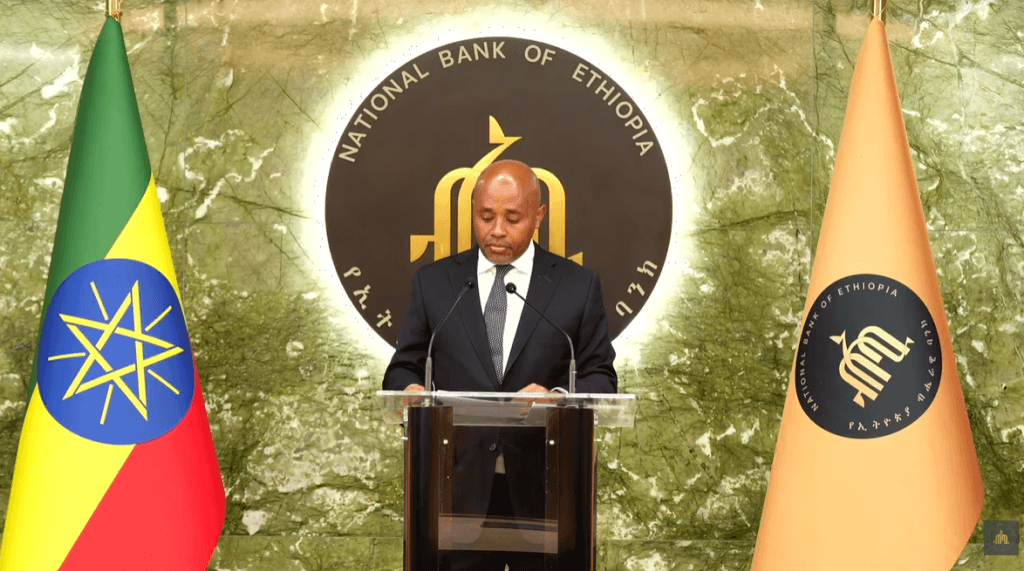
The biggest monetary policy decision of the decade came out of the Monetary Policy Committee’s seventh meeting: the NBE fully removed the credit growth ceiling that had restricted bank lending since August 2023, and raised the National Bank Rate from 15 to 16 percent, the first hike since the interest-rate framework was introduced in July 2024.
The cap was born in an emergency, when inflation was running near 30 percent. It started at 14 percent annual credit growth, was loosened to 18 percent in December 2024, then 24 percent in September 2025. Now it is gone entirely, and the central bank was careful to say what that does not mean: this is not easing. Interest rates, reserve requirements, and liquidity management tools take over from administrative decree, and the NBE has armed itself with a targeted safeguard, the power to slap additional reserve requirements on individual banks whose loan-to-deposit ratios run too hot, rather than punishing the whole sector.
The timing is deliberate but not comfortable. Inflation, which touched single digits (9.7 percent) in December 2025 for the first time in almost a decade, has rebounded to 13.4 percent in May, with food inflation at 15 percent, driven largely by the fuel and transport cost shock from the US–Iran conflict. The rate hike keeps real rates positive, barely, and signals the NBE intends to defend that margin.
There was also good news for exporters tucked into the announcement: the FX transaction commission was cut from 2.5 to 1.5 percent, and the foreign exchange surrender requirement dropped from 50 to 30 percent, letting exporters keep a bigger share of their hard-currency earnings.
Banks that were legally barred from lending freely for three years now face no ceiling at all, in a system flush with liquidity (91-day T-bill yields at 11 percent, auctions oversubscribed by roughly Birr 667.8 billion). Whether the 16 percent rate is enough to keep that pent-up lending from reigniting inflation is the defining test of Ethiopia’s new monetary framework.
The IMF’s Fifth Review lands a day later, with homework attached
Talk about timing. Twenty-four hours after the MPC’s announcement, the IMF published its Fifth Review of Ethiopia’s $3.4 billion Extended Credit Facility and the report reads like a companion volume to the credit cap decision.
The headline finding: private sector credit was already expanding by around 50 percent year-on-year before the cap came off, while credit to state-owned enterprises fell 10 percent. The Fund called the NBE’s current stance appropriate but warned it should be ready to tighten further if inflation pressures persist.
The most pointed recommendation targets the central bank’s role as sole buyer of artisanal gold. The IMF wants the NBE to prepare a full exit strategy from the gold market by December 2026, and a plan by September to phase out the 5–15 percent premium it pays miners above international prices. The reason: gold purchases, paid in birr, have become a major engine of money creation, reserve money growth hit 67 percent year-on-year in March, forcing the NBE into increasingly costly open market operations to mop up the liquidity it is itself injecting.
The review also sketches the next phase of debt market plumbing: a revised T-bill and bond issuance directive by October 2026, a master repo agreement by December, and a secured repo market to deepen the local bond market.
The gold arrangement helped rebuild reserves and fund 14 FX auctions worth $2.5 billion this fiscal year. But it has become the liquidity leak in a system that just gave up its main lending control. Expect the gold market exit to be one of the most closely watched reform items of the next 18 months.
NBE digitizes account numbers for new traders
A smaller but practical piece of reform: the NBE, working with the Ethiopia Customs Commission, will now issue NBE Account Numbers to newly licensed importers and exporters directly through the Customs Electronic Single Window, cutting out a separate administrative step in trade registration. Existing traders keep their current numbers. Modest on its own, but another brick in the ease-of-doing-business wall.
Capital Market
Global Insurance brings 737,352 securities into the regulated fold
The Ethiopian Capital Market Authority approved Global Insurance S.C.’s Registration Statement on June 30, registering 682,180 existing shares and approving 55,172 new shares to be offered to existing shareholders through a rights issue, all under the Public Offer and Trading of Securities Directive No. 1030/2024.
ECMA was careful, as always, to note that registration is not an endorsement of the securities. But the steady drumbeat of registrations, bank by bank, insurer by insurer, is how Ethiopia’s securities framework becomes real: one balance sheet at a time moving from informal share dealing into a regulated, disclosed system.
Insurers are following banks into the registration pipeline. Every registered issuer today is a potential listed ticker tomorrow.
Market Snapshot


Macro & The Economy
Your car is about to get its own tax bill
Capital reports that the government is preparing a new vehicle ownership tax, the next step in a fiscal reform agenda that has been signaling this move since the Finance Ministry first floated a motor vehicle circulation tax alongside fuel VAT and excise measures. With Ethiopia’s tax-to-GDP ratio sitting below 10 percent, among the lowest in Sub-Saharan Africa, the government has made no secret that widening the domestic tax base is a priority, and vehicles, long taxed heavily at import, are now set to be taxed in ownership too.
For households, another cost layered onto already elevated transport expenses. For the treasury, a recurring revenue stream that doesn’t depend on imports. Watch for the rate schedule and whether EVs get preferential treatment, consistent with the government’s electrification push. Source: Birrmetrics
Cooperatives close the year at 89.2 percent of target
The Ethiopian Cooperatives Commission reported that the sector generated more than $362 million in capital and over $81 million in exports in 2025/26, hitting 89.2 percent of its annual implementation target. Member savings in the savings-and-credit subsector passed $707 million, loans to members topped $776 million, marketing share jumped more than 50 percent year-on-year, and production output reached 3.5 million tons. Commissioner Getnet Zegeye’s message to the sector: the transformation must now be validated by verifiable, sustained results, not just ambition.
With the amended Cooperative Proclamation set to allow outside investors to hold up to 10 percent of a cooperative’s shares, this sector, 89,000-plus primary cooperatives strong, is quietly becoming an investable asset class in waiting.
Energy & Infrastructure
Aysha wind farm secures $110 million from AfDB and a new model for Ethiopian power
The African Development Bank approved up to $110 million on July 15 for the 300 MW Aysha Wind Project in the Somali Region, Ethiopia’s largest wind farm once complete, and, more importantly, its first wind-based Independent Power Producer.
The $508 million project will be developed, owned, and operated by UAE-based AMEA Power, with Ethiopian Electric Power buying all output under a 25-year power purchase agreement. The AfDB package combines $80 million from ordinary resources, $20 million from the Clean Technology Fund, and $10 million from the Sustainable Energy Fund for Africa, with the Bank helping mobilize a further $381.1 million in debt from other development finance institutions, including a planned IFC investment.
For decades, Ethiopian power meant state-financed, state-operated generation. Aysha shifts construction and financing risk to the private sector while the government expands capacity off its own balance sheet, a template Ethiopia will need again and again, with EEP managing a pipeline of over 20 PPP and IPP projects. Expected output: around 1,189 GWh of clean electricity per year.
Business & Trade
Industrial park exports more than double to a record $266.9 million
Manufacturers in industrial parks and special economic zones managed by the Industrial Parks Development Corporation earned $266.9 million from exports in 2025/26, up roughly 115 percent from the $124 million recorded a year earlier, and the highest annual figure in the corporation’s history, CEO Fiseha Yitagesu announced at the annual performance review in Hawassa.
One caveat worth keeping: the figure covers only IPDC-managed facilities, 11 special economic zones and three industrial parks, including Hawassa, Bole Lemi, Kombolcha, Adama, and Dire Dawa, not Ethiopia’s privately developed or regionally managed parks, whose exports are reported separately.
After years of parks running below potential, a doubling of export earnings suggests the combination of FX reform, surrender-requirement relief, and SEZ incentives is starting to bite. The next test is whether occupancy (88 percent last year) converts into sustained FDI.
Aid & Food Security
US approves up to $235 million in food aid for Ethiopia and Sudan
The US Department of Agriculture reached an agreement in principle with Catholic Relief Services on July 14 to deliver up to $235 million in emergency food and nutrition assistance to Ethiopia and Sudan, mobilizing more than 110,000 metric tonnes of US-grown commodities under Title II of the Food for Peace Act. CRS will implement through its existing East Africa operations, including the Joint Emergency Operation in Ethiopia.
After the upheaval in US aid architecture, with USAID’s humanitarian functions folded into the State Department and Food for Peace moved to USDA, this is one of the largest food assistance commitments to reach Ethiopia under the new structure. For communities facing acute need, the mechanics matter less than the tonnage.
Deep Dive of the Week
Walking the Quantitative Tightrope
In 1974, Philippe Petit walked a wire between the Twin Towers, held up not by courage but by rigging: a lattice of guy-lines, each tensioned against the others. Cut one, and the wire doesn’t wobble. It whips.
This week’s deep dive argues that Ethiopia’s monetary policy has just stepped onto its own wire. The credit cap was crude, but it was a net. Now the economy hangs on interlocking parts, the 16 percent policy rate, a Birr 3 trillion interbank market, an oversubscribed T-bill market, a liberalized FX regime, fiscal discipline, 2.1 months of reserves, and an IMF program whose certification keeps creditors at the table. The system is efficient because everything connects to everything, and fragile for exactly the same reason. The piece maps how a single slip in fiscal discipline could cascade through the program, the debt deal, the reserves, and the birr, and lays out the NBE’s five-point playbook for keeping every anchor holding at once.
📖 Read it here: Walking the Quantitative Tightrope as Ethiopia’s New Monetary Framework Enters a New Era
Bonus read: The Role of Capital Markets in Ethiopia’s Economic Transformation
Meti Kumera steps back from the weekly noise to ask the fifty-year question: why did Ethiopia’s bank-only financial system hold the economy back, and what would it actually take for the ESX era to change that? From the Share Dealing Group of the 1960s to Wegagen’s opening-day listing, the undersubscribed-then-tripled TELE IPO, and the 66 prospectuses now sitting on ECMA’s desk, this is the primer to send to anyone still asking why the capital market matters.
📖 Read it here: The Role of Capital Markets in Ethiopia’s Economic Transformation
🎧 On the Podcast
A new episode of the StockMarket.et podcast is live, tune in for the conversation on YouTube.
Ethiopia spent three years building a market-based financial system behind the safety of administrative controls. Last week, it took the controls away. The rate is up, the cap is gone, the IMF has published the checklist, and from here on, the reform program has to balance without a net.
Keep your coffee strong. See you next Monday. ☕